Showing posts with label financial crisis. Show all posts

Sunday, February 7, 2016

Where to find growth in the post QE era?

The market turmoil over the last few weeks has indicated that businesses are uncertain where they will see growth, now that the QE has ended in America and the interest rates are on the rise. The Chinese economy which had overheated, is now cooling off and the demand for oil, iron ore, copper and other commodities are dropping along with their prices. China is suffering from an over-capacity problem right now.

I think in this environment, the input costs for manufacturers would be very low since the price of oil is at an all time low and the price of copper and iron ore are also close to their all time lows. This should boost the margins for the manufacturers if their sales are constant. So all else being same, the manufacturers should be able to report better profits. 

But the demand side is weak as the consumer is not spending a lot of money. This is due to the fact that they are cautious in this uncertain environment. In this situation, lowering the prices could be a good solution to increase sales. Considering the low input prices, manufacturers of goods should be able to sell their goods at a much lower price now vis a vis one year ago. Price of oil has dropped from the $50-60 range in 2015 to $30 per barrel today.   Iron ore prices have dropped to a third of where they were one year ago.  Copper prices are down 8% year over year. 

There could be demand for commodities from building heavy infrastructure such as a rail road in Afghanistan or solar power farms in Sahara in Africa. India, which is facing a power deficit right now, is planning to build 5 new nuclear reactors in collaboration with the French. I think there are business opportunities and investing opportunities present today that could yield dividends going forward.

Wednesday, January 6, 2016

Happy New Year 2016!

2016 started with a bang as the Chinese markets crashed 7% before trading was suspended. You can find a good account of the opening day volatility in the markets in this blog post by Caroline Hyde, a correspondent for Bloomberg News.
The weak PMI data that came out just before the crash is just the straw that broke the camel's back. US tightening and anticipation of further rate hikes could be the prime mover here. China relies heavily on US consumption for manufacturing exports and the impact of the US rate hikes should have been felt in China much sooner. With further rate hikes slated in USA, there is no hope of a demand side stimulus. 
On the question of interest rate increases in USA, it seems USA is not yet ready for more interest rate increases. The biggest loser on the rate hikes could be the US government, which could see a rise in bond yields as demand for low return assets would reduce corresponding to the higher cost of capital in borrowing from the Fed. However the market uncertainty from the rate hikes is so high that the risk adjusted return from government bonds is still attractive, as was evident in last rate hike, when the government bond yields actually reduced. Link to related Bloomberg story.
China is sitting on another time bomb right now which is the state and municipal debt. The state and local governments are under increasing pressure to raise revenues to sustain their high debt levels, and the weak PMI data maybe an indicator that this may not be an easy job. Link to related Bloomberg story.

Tuesday, September 15, 2015

BITCOIN AND RELATED BUSINESSES

This presentation was prepared for the E-BUSINESS COURSE taught by Prof. Vijay Shrotriya. This presentation covers the regulated aspects of the bitcoin currency. There is a large shady marketplace for bitcoins that is unregulated and exists outside of USA and Australia. Regulating the dark market is difficult due to the decentralized nature of the bitcoin. However, proactive and corrective actions such as those taken in USA and Australia are necessary to check the growth of the dark markets which are unregulated. Turning a blind eye to these dark exchanges is not going to solve the problem of money laundering using the bitcoin which is often time used by drug dealers and terrorist networks.


Wednesday, September 9, 2015

A Hundred Small Steps (Contd.): Market reforms within existing legal and institutional framework

First a comment on my previous blog post in this series: Creating Liquid and Efficient Markets

"Consider the last 2 weeks turmoil in the financial markets. On Aug 24 the markets dropped by around 1000 points as fears from slow down in China and the US rate increases created a flight to safety in the markets. As the money moved out of Indian equities, the Rupee dropped to a 12 month low to 67 to a US Dollar. Subsequently, as the rate hike fears in USA were eased and the Chinese government reduced the rates, the markets recovered and so did the Rupee to 65 to a US Dollar. Now suppose we had a robust and liquid corporate bond market open to foreign investors. The money that moved out of equities at the start of the down swing, would have moved into corporate bonds and the Rupee would not have been hit so hard."


The suggestions given in the section on market refoms have been alluded to in earlier sections of the report and so have been superficially covered in the previous blog posts in this series. I find the treatment in the report to be very complete and am unable to contribute to the suggestions expressed in any way. So I  would suggest the reader to read this section on the report on pages 133 to 135 here: A Hundred Small Steps: Raghuram Rajan

Sunday, August 30, 2015

A Hundred Small Steps: Creating Liquid and Efficient Markets

This blog post is in continuation of my series of blog posts on RBI Governor Raghuram Rajan's report titled "A Hundred Small Steps" published when he was with the Planning Commission of India.

This post focuses on Chapter 5 of the report, which deals with establishing Efficient and Liquid Markets. This section of the report delves into what could be changed in the structure of the financial markets in India to make them more resilient and liquid. I will try to describe the contents of the report here, with my analysis where possible.

First the definitions. Market efficiency is the degree to which information and forecasts about the future are impounded into financial prices. Liquidity pertains to the ability to transact with low transaction costs. Liquidity has 3 aspects: immediacy, depth, and resilience. Immediacy refers to the ability to execute trades of small size immediately without moving the price adversely (also called low impact cost). Depth refers to the impact cost suffered when doing large trades. Resilience refers to the speed with which prices and liquidity of the market revert back to normal conditions after a large trade has taken place.

The concepts of efficiency and liquidity are linked. In order for markets to be efficient, market participants who obtain information have to be able to trade on that basis and impound that information into the prices. For economic agents to have an incentive to expend resources in information processing and forecasting, markets must be liquid, else any profits from the activity will be dissipated in transaction costs alone. Expensive or infeasible transactions reduce the profits from successful forecasting.  This (in turn) inhibits the investments made in information processing and forecasting. Market liquidity is thus a critical precondition for market efficiency. In turn, market efficiency assures uninformed participants that market prices are up to date and reflect fundamentals, so they can trade safely. This in turn provides volumes that ensure liquidity.

The below table highlights the state of the Indian markets from the 3 aspects of liquidity:

A particularly important point to note here is the lack of progress. In the period from 2003 to 2008, 3 elements have come through the onset of immediacy with near money options on index and liquid stocks, the onset of immediacy and depth on the interest rate swap market, and the onset of immediacy on some commodity futures products. 

The main reason why so many markets are illiquid and inefficient are listed as follows: 

1. Banning of products and markets: Currency futures and commodity options are banned in India. A missing market can hamper the efficiency of other markets also. The absence of interest rate futures can hurt the treasury market. 

2. Rules that impede participation of firms and individuals in certain markets for reasons other than sophistication. eg. domestic individuals cannot participate in currency markets (outright ban), banks are prohibited from adopting long positions in interest rate futures (regulatory restrictions on some kinds of activities), all FIIs put together have to keep their ownership of corporate bonds below $1.5 billion (quantitative restriction)


3. Inadequacies of financial firms arising out of their ownership, size and other reasons. The institutional structure of market participants is shaped by the forces of competition and regulation. When firms face competition from market share, they are forced to find new ways of serving customers. It is this pressure that, over time, creates highly competitive companies that are able to bring down costs through technological innovation and better management of resources. The inadequacies of Indian financial institutions can be traced at least partly to the forces that restrict competition. 

State ownership of financial institutions is a major factor that inhibits competition. A second factor is restrictions on ownership and shareholding. This applies especially to banks and exchanges, clearing corporations, and depositories. Limits on how many shares an individual can hold and limits on foreign ownership make it difficult for new institutions to be started. This reduces the competition pressure on incumbents, and slows down the pace of development of market institutions. 

In short, the deficiencies in Indian financial markets stem from missing markets and missing actors. The way to address this issue is to open the markets, equalize market rules for all participants, and in removing rules that ban specific players only from certain activities. The second problem is deeper and requires more long term efforts, that of improving the capabilities of financial firms. The way to do this is to increase the competitive pressures in the market ecosystem by removing constraints in the way of entry of new players.

4. A silo model of regulation  and the structure, incentives, and staffing, of regulatory institutions that results in barriers to innovation and competition.

There are 2 factors of consequence here: 
1.  India uses a silo model where financial markets are broken up across 3 agencies: SEBI, RBI and FMC. There are are hard constraints that separate firms and players in one silo from operating in other silos. These constraints reduce competition, hamper economies of scale and scope, and impede the flow of successful institutional arrangements and ideas from one part of the financial markets to the other. 
2. Steep barriers to innovation are in place. New ideas are banned unless explicitly permitted. A great deal of what would be considered ordinary activities in the world of global finance is incompatible with existing laws and subordinate legislation. 

5. Frictions caused by taxes:

Different tax treatment is applied to different types of investments and transactions. Taxation plays an important role in determining the returns generated by trading. When transaction taxes are high, liquidity disappears when the markets go down. 

Suggested reforms:

To achieve true economic benefits, we need:
1. The availability of complete markets where agents are able to trade and hedge all the risks that they need to manage, and the existence of adequate liquidity in all these markets.

2. A regulatory structure that protects customers from fraud, but without imposing undue costs and without creating barriers to entry, innovation, and competition.

The reforms that would achieve these objectives have 3 broad elements:

1. Reforms within existing legal and institutional framework.

2. Capital account liberalization.

3. Merger of regulatory and supervisory functions for all organized financial trading into SEBI and strengthening the legal foundations of market regulation.

4. Implement the Debt Management Office.

I will describe these proposals in the upcoming blog posts.


Wednesday, August 5, 2015

A Japanese Decade for China


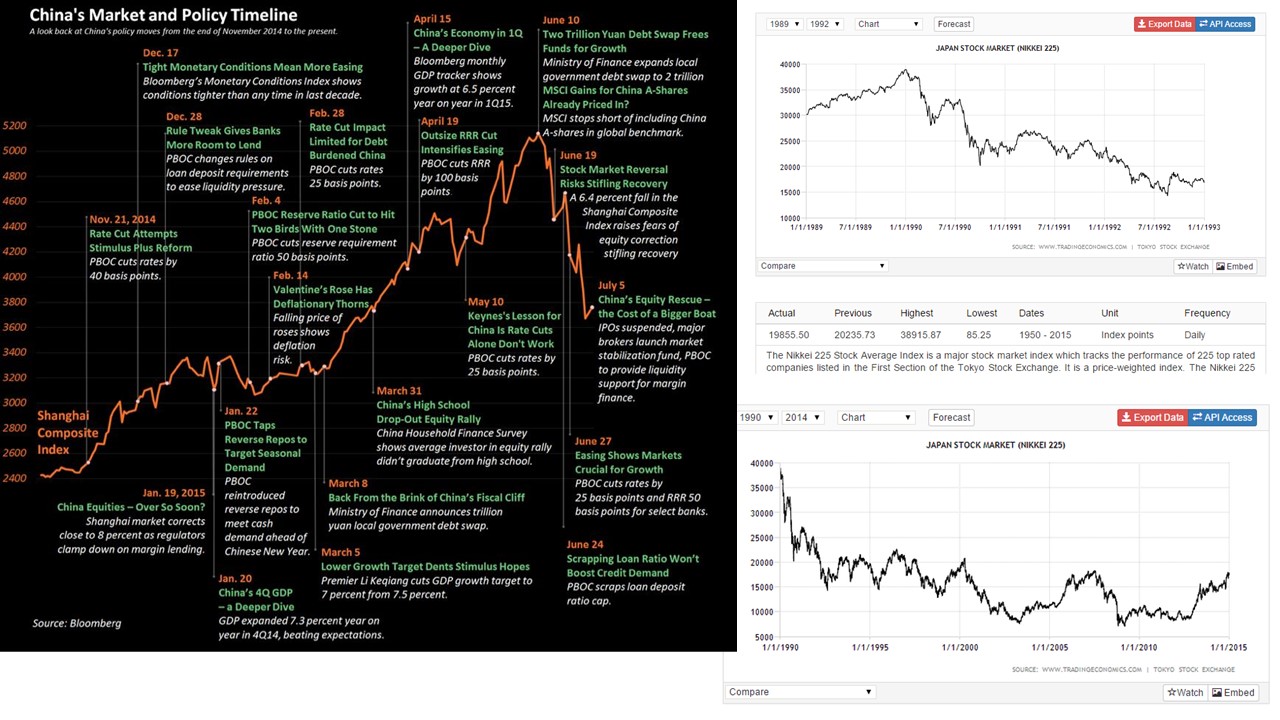
There are many parallels between yesterday's Chinese equity market crash and the Japanese equity market crash of 1990. The Japanese crash in 1990 was led by a crash in real estate prices and the same happened in China almost a year ago, following which Chinese government started an aggressive stimulus. Read full details here:  These 5 charts link the Chinese stock market crash to problems in property. Source: WEF   The market patterns too are exactly identical for both the crashes as can be seen in the attached figure.

Details of the Japanese market crash can be found on Wikipedia here: Japanese Asset Price Bubble  Reports on the Chinese market crash are available here: Chinese stocks plunge to a 3 month low 

China and Japan are both industrial economies dominated by the exports sector. Leading into the crash, both the economies were being driven largely by exports of manufactured goods. The demographic trends in Japan and China are also very identical because of the fact that they are pretty closed economies with respect to immigration and the population ages are tending to increase. In China this is partly due to the one child policy of the government.

Given the identical demographic, economic and financial trends, it seems as if China is headed towards the Japanese Lost Decade of the 1990s. The equity markets did not give any net returns over the 1990s in Japan and the economy was plagued with deflation and lowering corporate profits. Only the Japanese export powerhouses were able to grow in this period. Details of this are also available on the previously shared Wikipedia link. Many efforts were made to revive the economy and produce inflation and growth and they all failed.

This changed with the economic policies of Shinzo Abe, popularly known as Abenomics. He introduced a quantitative easing program and starting injecting money into the system through government and corporate bonds. This rapidly devalued the Yen and started increasing the demand, leading to the first recorded inflation of prices since the crash of 1990. The Japanese stock markets too have been seeing a rising trend since Abenomics have started.

In light of this, I think China can draw a number of valuable lessons from the policies of Shinzo Abe in Japan. Here are few articles on the same:

Investing in Japan: The Impact of Abenomics

What the 1990 Japanese stock market crash can teach us about the Chinese stock market crash

If history is a lesson, the future for China can be different from that for Japan.


End Game in Greece?

The Greek Crisis is looming over the head of the World Economy and speculations are rife about what the Greeks plan to do now.

The $1.1 billion payment that is looming ahead for Greece by the end of this month is going to be the last nail in the coffin that Greece is in right now. By all measures it seems that Greece does not have the means to make this payment. Link to Bloomberg story on this

The Greek situation is akin to the End Game Effect in Competitive Strategy where in, if a game with finite repetitions is in the last stage of repetitions, the participants are incentivised to actually misbehave knowing that there is no other repetition of the game. As an example you can think of football, where you are allowed 3 yellow cards before a red card. There are more yellow cards in the final minutes of play then in the earlier minutes.

Greece is at the end of its game. If it defaults, it goes out of the Euro and gets a separate currency. The currency would probably crash given the state of the Greek economy and you would see an economic crisis worse than the present austerity in Greece. If Greece decides to make the payments, the level of austerity required is unacceptable to the present government. However, considering the finite chance that the devalued currency would aid the Greek tourism industry, Greece would be incentivized to default (End Game Effect).

Such a situation could be avoided if Greece were to undergo a GM style debt restructuring from 2008. When GM was on the verge of bankruptcy and asked for debt restructuring, the government bought a controlling stake in GM. The US Government sold off its stake for a handsome profit after GM was back in the black a few years later.

Greece could ask for a similar debt restructuring from EU to extend its 30 year loans to 50 year loans and reduce the debt payments. In return, EU could get a controlling stake in Greece through a majority vote in Greek Parliament. This could avoid the End Game Effect that has produced the stale mate in present debt negotiations.

Are emerging market economies becoming a drag to global growth?

I read this article titled "Emerging markets: Trading blow" in The Financial Times last week. The article describes how a drop in Chinese demand has reduced the GDP growth in emerging market economies - Brazil, Russia, India and China. The article states that GDP growth for 2015 in the emerging markets is going to be close to 0%. This is a very significant fact because emerging markets today account for 35% of global GDP in nominal terms and 52% of global GDP in purchasing power terms. The last time emerging markets slowed down to this level was in 1999 when they accounted for 23% of global GDP in nominal terms and 35% in purchasing power terms.

Brazil recently unveiled a $35 billion infrastructure stimulus plan to support an economy which shrank in 1Q 2015. Much of the growth in the last decade was the result of heavy infrastructure spending in China, which built more high speed rail in the last 10 years than the rest of the world combined. Being the most efficient means of transportation known to man today, the strategic value of China's High Speed Rail today is priceless.

India today is at rank 44 in IMD world competitiveness rankings Amongst the other factors, infrastructure development has been stated as an important challenge for India. In light of these facts, Prime Minister Narendra Modi has been working on the Smart Cities development theme and will be announcing funding of 98000 crores for 100 smart cities and a new urban renewal mission for 500 cities. Questions have been asked whether having 100 smart cities will dilute the scope of individual projects since a single phase of the Delhi Metro (Phase 2) cost up to Rs. 19000 crores.

This project dwarfs in comparison to what China has done with its high speed rail but the steps of the government are in the right direction nonetheless. This leads to an important question - "Does a strong Rupee lead to lower costs of commodities such as iron ore and copper and thus could it lead to larger scope on infrastructure projects?" It also leads to a questions - "Can India produce a commodities boom the way China produced it for the last 10 years and build infrastructure which is at par with the developed world?" India ranks at 54 in the 2014 World Bank Logistics Performance Index Infrastructure Rankings. This ranking would be a big obstacle to PM Narendra Modi's Make in India campaign.