Showing posts with label japan. Show all posts

Sunday, February 7, 2016

Where to find growth in the post QE era?

The market turmoil over the last few weeks has indicated that businesses are uncertain where they will see growth, now that the QE has ended in America and the interest rates are on the rise. The Chinese economy which had overheated, is now cooling off and the demand for oil, iron ore, copper and other commodities are dropping along with their prices. China is suffering from an over-capacity problem right now.

I think in this environment, the input costs for manufacturers would be very low since the price of oil is at an all time low and the price of copper and iron ore are also close to their all time lows. This should boost the margins for the manufacturers if their sales are constant. So all else being same, the manufacturers should be able to report better profits. 

But the demand side is weak as the consumer is not spending a lot of money. This is due to the fact that they are cautious in this uncertain environment. In this situation, lowering the prices could be a good solution to increase sales. Considering the low input prices, manufacturers of goods should be able to sell their goods at a much lower price now vis a vis one year ago. Price of oil has dropped from the $50-60 range in 2015 to $30 per barrel today.   Iron ore prices have dropped to a third of where they were one year ago.  Copper prices are down 8% year over year. 

There could be demand for commodities from building heavy infrastructure such as a rail road in Afghanistan or solar power farms in Sahara in Africa. India, which is facing a power deficit right now, is planning to build 5 new nuclear reactors in collaboration with the French. I think there are business opportunities and investing opportunities present today that could yield dividends going forward.

Tuesday, November 24, 2015

Where are the bottlenecks to growth in India right now?

So this is the question on my mind - given the situation that India is in right now, where should we be investing the limited funds available to us? The situation being that government budget is constrained by the fact that the fiscal deficit should not be more than 5% of GDP. With the Goods and Services Tax coming up next year, there will be revenue sharing between center and states and the budget of the Central Government will be constrained even further. At present the government is finding it hard to implement the recommendations of the 7th pay commission. The manufacturing sector is lagging as government is not undertaking major projects (such as new dams, nuclear reactors, smart grids, etc.) at this stage and this is showing in corporate earnings of the industrial companies. The economy is in a dismal state right now.

The Goods and Services tax is expected to be a friendlier tax regime than the present VAT which suffers from 2 important drawbacks: 1. Cascading taxation and 2. Inability to tax imports on par with the domestic production. With the states sharing the revenue from the single GST tax regime, the Center will have to delegate increasing responsibilities to states than done previously. This would also open up the opportunities for state level debt and state government bonds similar to the central government bonds. A constitutional amendment will be required to enable the states to collect the GST.

The Congress had brought the GST bill in Parliament in UPA2 regime but were not able to bring the states on consensus on a common tax rate and so the bill was stalled. Now the BJP has been able to bring the states to consensus on the GST tax rate and the Congress is blocking the GST bill in Rajya Sabha.

The second factor that can boost the economy is Foreign Direct Investment in critical sectors such as power (nuclear reactors, smart grids, etc.) and transportation (high speed rail). These are very attractive sectors commercially and corporations in Japan and USA provide debt financing at low interest rates for such environmentally friendly projects. For example, Japan has offered to finance the the first bullet train in India, having a cost of $15 billion, at a 1% interest rate.  There are a lot of opportunities in the nuclear power sector after the India and USA reached a joint agreement on development of civilian nuclear power (Link to September 2015 story).  GE-Hitachi had started discussions on building nuclear power plants in India (Link to February 2015 story).  These deals are stalled right now.

Generating more nuclear power will help reduce our dependence on coal imports for generation of electricity. This could potentially solve the persistent power deficit problem in this country and make power production immune to supply side shocks from high price of coal and natural gas when the Rupee depreciates.

The FDI regime in India can be changed from limited FDI (49-50% in most sectors) to 100% FDI with a caveat that the business has to support local jobs. This has been implemented in multi brand retail where we have seen Walmart set up stores in India and source large amounts of their merchandise locally. USA has similar FDI norms where car manufacturers have to manufacture at least half of their cars in USA. I believe this would make the FDI route more attractive for businesses and multi national corporations.

I think these factors can significantly improve the growth prospects of the Indian economy at this point of time.


Wednesday, August 5, 2015

A Japanese Decade for China


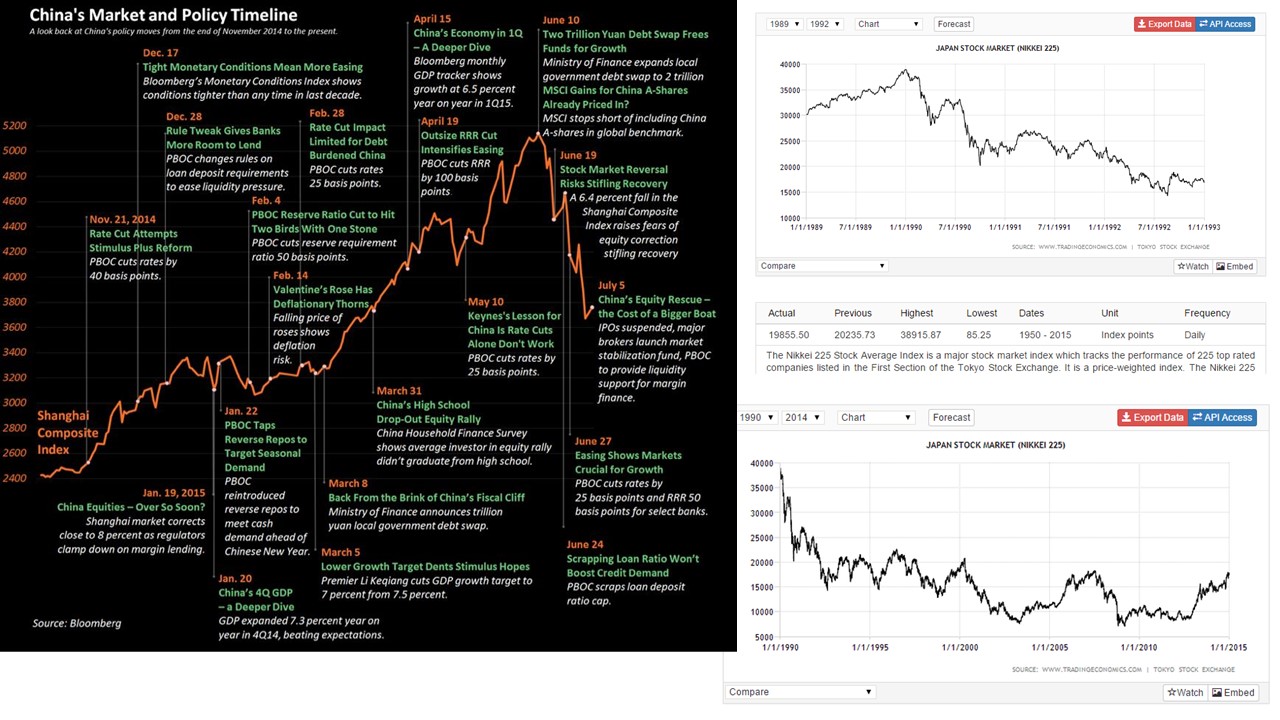
There are many parallels between yesterday's Chinese equity market crash and the Japanese equity market crash of 1990. The Japanese crash in 1990 was led by a crash in real estate prices and the same happened in China almost a year ago, following which Chinese government started an aggressive stimulus. Read full details here:  These 5 charts link the Chinese stock market crash to problems in property. Source: WEF   The market patterns too are exactly identical for both the crashes as can be seen in the attached figure.

Details of the Japanese market crash can be found on Wikipedia here: Japanese Asset Price Bubble  Reports on the Chinese market crash are available here: Chinese stocks plunge to a 3 month low 

China and Japan are both industrial economies dominated by the exports sector. Leading into the crash, both the economies were being driven largely by exports of manufactured goods. The demographic trends in Japan and China are also very identical because of the fact that they are pretty closed economies with respect to immigration and the population ages are tending to increase. In China this is partly due to the one child policy of the government.

Given the identical demographic, economic and financial trends, it seems as if China is headed towards the Japanese Lost Decade of the 1990s. The equity markets did not give any net returns over the 1990s in Japan and the economy was plagued with deflation and lowering corporate profits. Only the Japanese export powerhouses were able to grow in this period. Details of this are also available on the previously shared Wikipedia link. Many efforts were made to revive the economy and produce inflation and growth and they all failed.

This changed with the economic policies of Shinzo Abe, popularly known as Abenomics. He introduced a quantitative easing program and starting injecting money into the system through government and corporate bonds. This rapidly devalued the Yen and started increasing the demand, leading to the first recorded inflation of prices since the crash of 1990. The Japanese stock markets too have been seeing a rising trend since Abenomics have started.

In light of this, I think China can draw a number of valuable lessons from the policies of Shinzo Abe in Japan. Here are few articles on the same:

Investing in Japan: The Impact of Abenomics

What the 1990 Japanese stock market crash can teach us about the Chinese stock market crash

If history is a lesson, the future for China can be different from that for Japan.